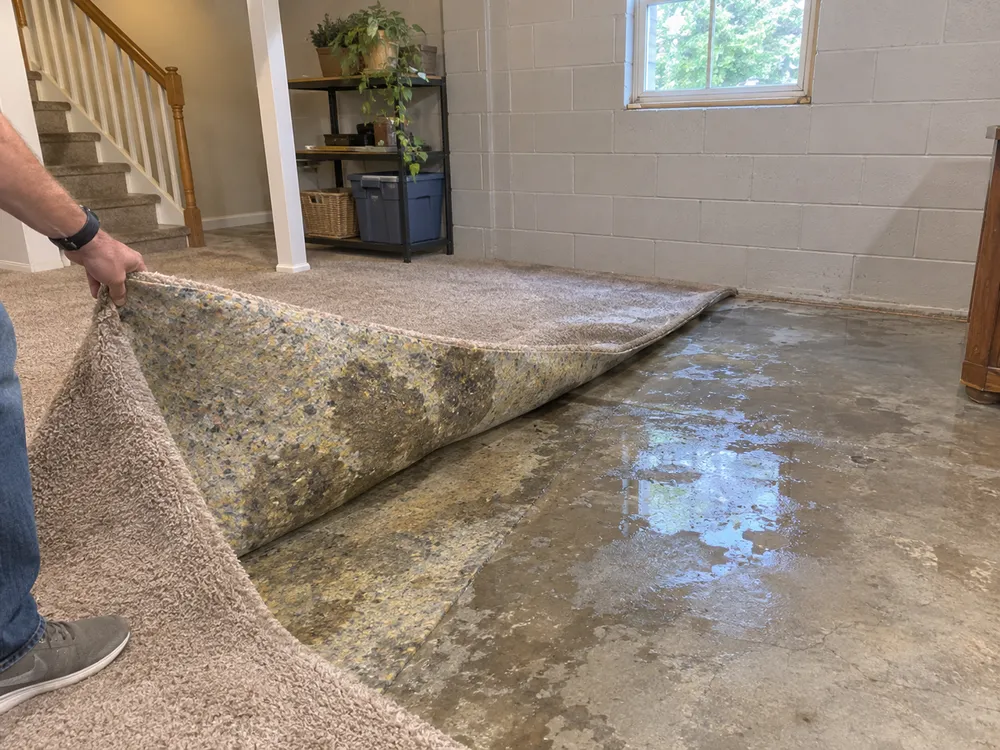
Can wet basement carpet be saved?
With clean water, often yes, if it dries fast. The EPA's guidance for carpet is to remove water with an extraction vacuum and speed drying with dehumidifiers and fans, within 24 to 48 hours (EPA). The LSU AgCenter says to extract water, prop the carpet up to dry and discard and replace the wet pad (LSU AgCenter).
When does the carpet have to go?
When the water was contaminated or the carpet did not dry in time. Sump pump failure is Category 2 water, and rising flood water and sewage are Category 3 (Massachusetts DPH). Massachusetts DPH says to discard carpet that has not been dried (Massachusetts DPH).
What about the concrete under it?
The slab has to dry before new pad goes down, and the EPA notes that mold may still grow even if materials are dried within 48 hours (EPA). Check the bottom of nearby drywall and wood framing too.
What does carpet water extraction cost?
HomeGuide lists national water extraction and drying ranges of $4 to $6 per square foot for clean water, $6 to $9 for gray water and $9 to $12 for black water (HomeGuide). See carpet water extraction cost.
Common questions
Can I dry basement carpet with a shop vac?
A shop vac pulls some water, but a truck-mounted or portable extractor removes much more. The pad usually still needs replacing.
Why does the basement smell musty after drying?
Moisture may still be in the pad, the slab or the bottom of the walls. Get readings.
Is basement seepage covered by insurance?
Groundwater and seepage are often excluded. Sudden plumbing leaks are more often covered.
Related guides
Sources
- EPA: Mold Remediation in Schools and Commercial Buildings, Table 1
- LSU AgCenter: safe removal and cleaning of floors after a flood
- Massachusetts DPH: quick reference, water damage response in buildings
- HomeGuide: water damage restoration cost
Last reviewed November 13, 2026. This guide is general information, not legal, insurance or medical advice.