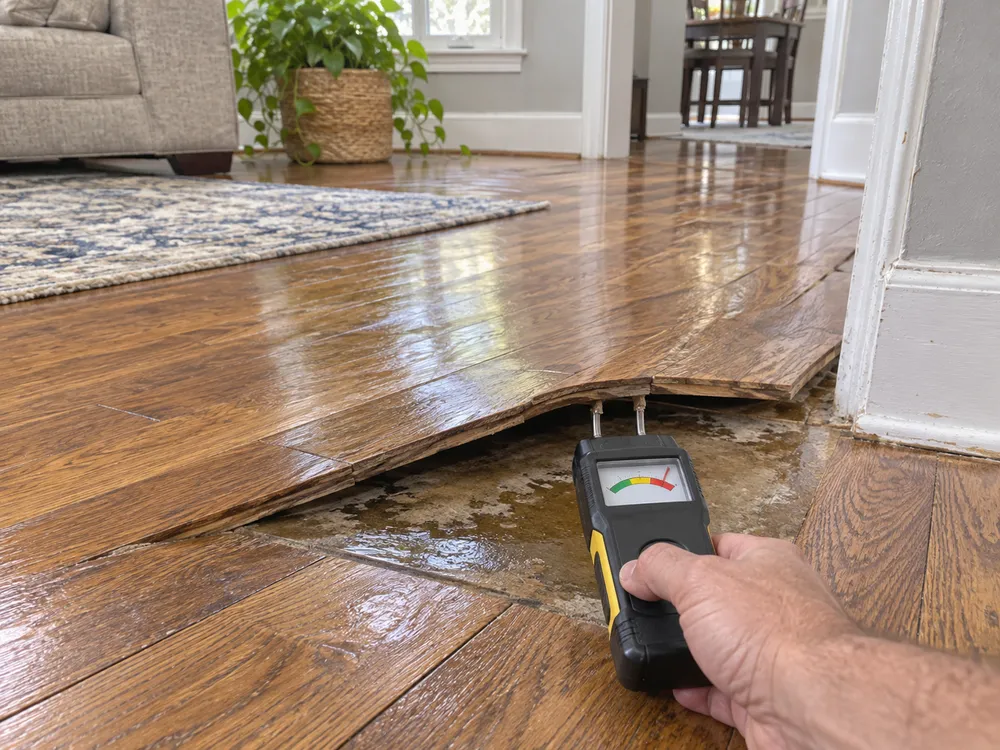
Can wet hardwood floors be saved?
Often, if they are solid wood and dried quickly. The LSU AgCenter says solid wood flooring usually can be cleaned, dried and reused, while engineered wood that swells or delaminates should be replaced (LSU AgCenter). Hardwood Floors magazine says flooring that has buckled must be replaced where it buckled (Hardwood Floors magazine).
How is a hardwood floor dried?
The EPA says to remove moisture right away using dehumidifiers, gentle heat and fans, and to use caution with heat on hardwood floors (EPA). The LSU AgCenter suggests removing a board every few feet to reduce buckling (LSU AgCenter).
How do I know it is dry?
By readings, not looks. Hardwood Floors magazine says the target is within 2% of the expected moisture content in normal use, and to check unaffected wood in the home as a reference (Hardwood Floors magazine). Sanding cupped boards before they are dry can leave them crowned later.
What about the subfloor?
It has to dry too. The EPA says the subfloor under flooring must be cleaned and dried (EPA), and the LSU AgCenter notes a wood subfloor may swell or delaminate (LSU AgCenter).
Common questions
What is the difference between cupping and buckling?
Cupping is when board edges rise higher than the centers. Buckling is when boards lift off the subfloor, and buckled areas are replaced.
Should I sand cupped floors right away?
No. Wait until moisture readings are back to normal, or the boards can be left uneven.
Is engineered hardwood the same as solid?
No. Engineered wood that swells or delaminates is usually replaced.
Related guides
Sources
- LSU AgCenter: safe removal and cleaning of floors after a flood
- Hardwood Floors magazine (NWFA): assessing and addressing water damage
- EPA: Mold Remediation in Schools and Commercial Buildings, Table 1
Last reviewed November 13, 2026. This guide is general information, not legal, insurance or medical advice.